
"Why does my dog chew so much (and what can I do about it)?"
Updated: Jul 17

Do you wonder why your puppy or adolescent dog seems like a furry destruction machine?
You're not alone! Dogs, especially young dogs, chew for real physical and psychological reasons. Providing acceptable ways to fulfill these needs will go a long way towards preventing problems.
Here are some of the reasons for chewing, and suggested solutions
Breed Tendencies
Some breeds are selectively bred to want to carry or grip things(1). Once they have it in their mouth, chewing is a logical next step. Retrievers are high on this list.
Example: My young Labrador mix once tried to carry/drag home an 8-foot sapling that someone had cut down and left by the curb. I affectionately called her my 4-legged wood-chipper.
Health benefits of chewing
Chewing appropriate substances can help clean teeth and may even improve digestive function and jawbone health (you know how doctors tell us to exercise to maintain bone density? Jaws need exercise to form a strong foundation for the teeth)(1). The benefit to the jawbone may be one reason why puppy chewing intensifies during adolescence, once the adult teeth have emerged. This is when young dogs are most likely to gnaw on furniture and door frames (I’ll discuss alternatives below).

Psychological benefits of chewing
Reducing stress
Chewing can be an important coping mechanism for pet dogs living in a world of human rules and restrictions(1, 2, 4).
Example: I see this in my own dogs; when my anxious Aussie has had a tough day, she reaches for something from her box of legal items to gnaw or shred.
Improving learning
If you’re training your dog, giving them a chance to (literally) chew over the experience afterwards may improve learning efficiency.
From the research world: Dogs (from 3 different herding breeds) showed faster learning when they were given an edible chew after a training session (they chewed for an average of 15 minutes)(3).
Occupying their minds and exercising their instinct
Expending effort to obtain food is one of our dogs’ inborn survival instincts. Their ancestors survived by foraging for meals, which included gnawing on animal carcasses(1, 2). Providing chews is a simple way to enrich your dog’s life. You're allowing them to unleash that instinct to use their jaws.
Hopefully, I’ve convinced you of the importance of chewing. Now here are some recommendations and examples to get you started.
Recommendations for chews
The best recreational chew for your dog depends on their size, chewing style, and preference (4). Here are examples from dogs I’ve known (some names are changed for client privacy).
For irritated gums during teething
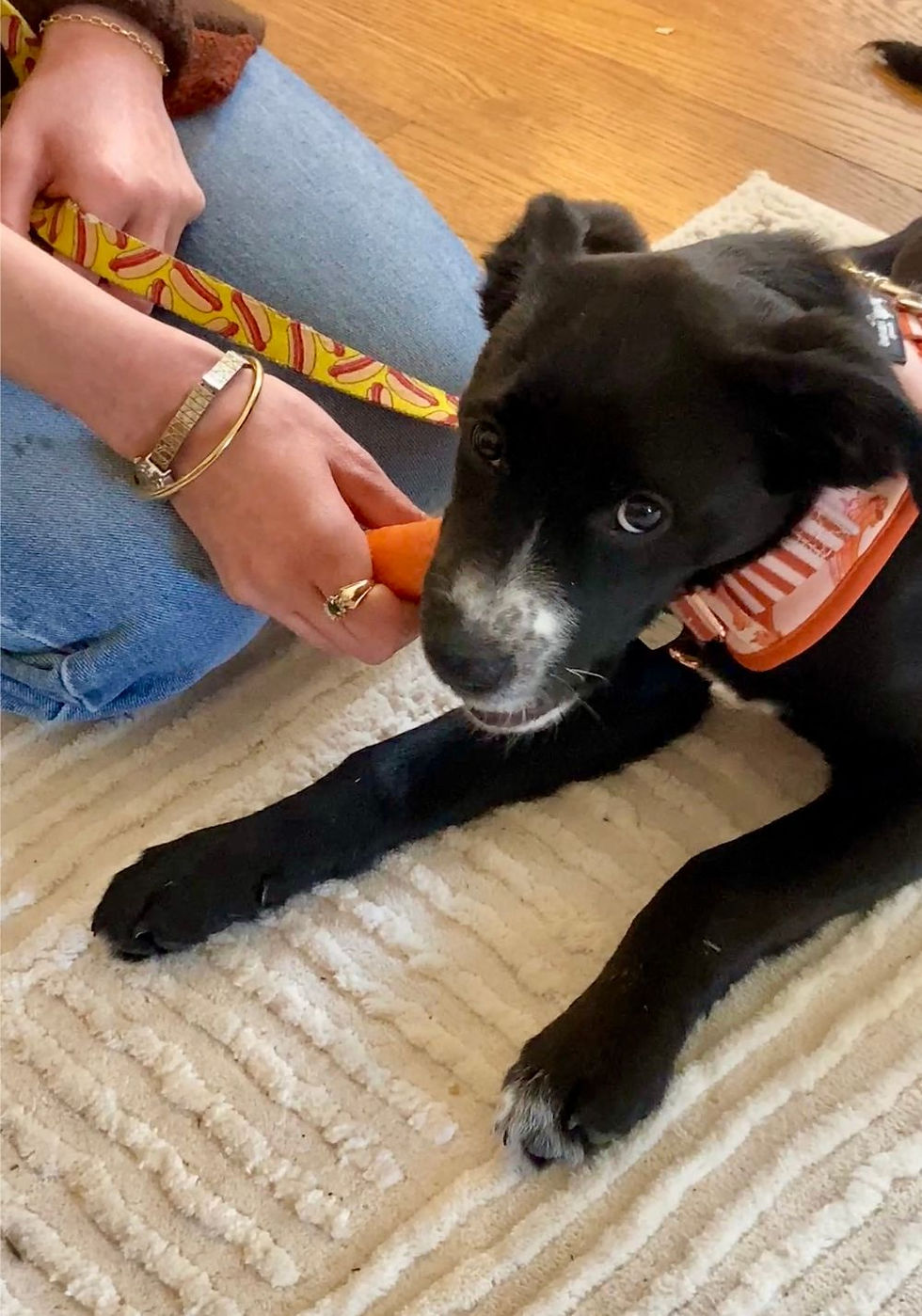
Pia, a puppy, had irritated gums because her adult teeth were emerging. Her guardian kept whole carrots in the freezer. The combination of cold and crunchiness soothed the soreness and satisfied Pia’s urge to gnaw.
Safety tip: It’s best to hold the carrot and end the activity when the carrot becomes short enough to be a choking hazard. It should be no less than the length of the puppy’s muzzle. Have a treat ready to trade for the carrot stub to prevent conflict.
Stress relief for moderate chewers
Adolescent Fiona is a Lagotto Romagnolo, a small retriever breed known for their high energy level. When not in constant motion, she chews vigorously to relieve the stress of being indoors.
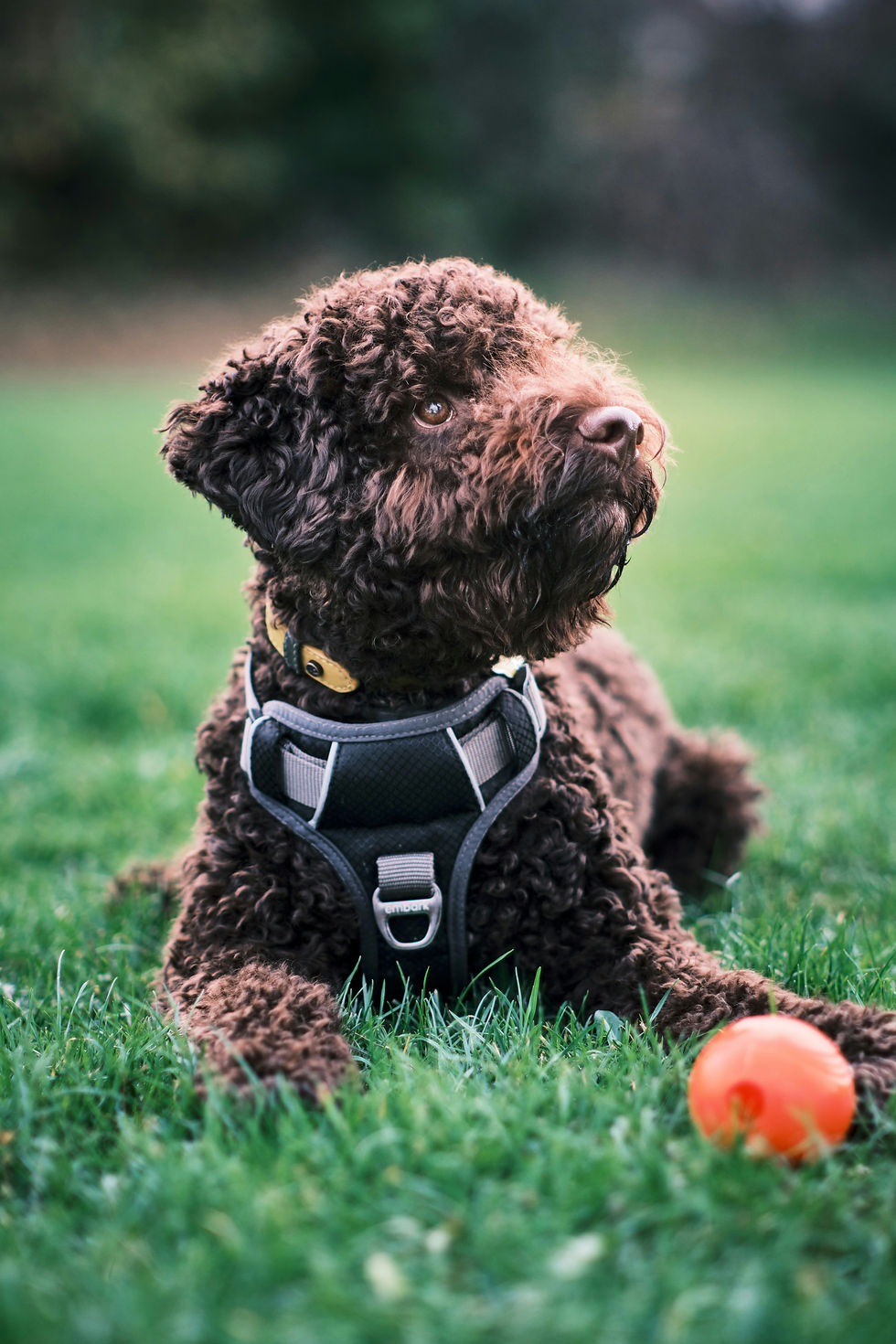
Fiona is a small dog with a narrow jaw, so she’s able to vigorously enjoy durable chews without fracturing them. A dog with stronger jaws might be able to break the same items into chunks that would be life-endangering if swallowed. Fiona is, however, able to tear up softer rubber toys such as Kongs, Toppls (West Paw Design), and Pupsicles (Woof) - all toys that my larger but mellower adult Australian Shepherds love and treat gently.
Fiona enjoys
Dogwood (a synthetic blended with wood fibers, by Petstages®) – her #1 favorite.
Nylabones (In my experience, the Nylabones with a knobbly texture are more popular with most dogs than the smooth ones).
The Bionic Urban Stick from Outward Hound.
Soft plastic, such as cottage cheese or yogurt tubs from the recycle bin (I don’t offer brittle plastic that would shatter into shards). Plastic beverage bottles make a crackling sound that many dogs love.
Remove the cap and plastic neck ring before offering a bottle.
If you provide a tall tub, make sure your dog's head can't get stuck inside it (always supervise the use of chews).

The chews above are safer than bones or antlers (commercially available bones, antlers, and hooves often are heat-treated, which makes them dangerously brittle). However, there is always some risk of cracking or breaking a tooth when using any durable chews. I balance the dog’s need for stress relief against the possibility of a cracked or broken tooth. Consider your dog’s personality, stress level, and your risk tolerance when deciding whether to offer these to your dog (3).
Fiona and my youngest Australian Shepherd shred the plastic tubs. Offer these only if your dog spits out the pieces they tear off.
For dogs who try to chew on wood furniture or door frames
When she turned about 5 months old, my Aussie pup Bess became obsessed with chewing wood. This is true for many of my clients’ pups. For them, as for Bess, coffee wood chews met their need and saved our furniture.
Coffee wood is safe for most dogs. It tends to flake instead of splintering when they chew it. Make sure the thickness of the piece you choose can stand up to the size and strength of your dog’s jaws. Discard and replace a chew when it is a bit longer than your dog’s muzzle. A chew that can entirely fit in your dog’s mouth is a choking hazard. I replaced the chew above when Bess chewed the ends into sharp points (the mom-voice in my head said, “Don’t run with scissors.”)


For dogs who prefer edible chews
Both my Australian Shepherds prefer edible chews now that Bess has outgrown her gnawing obsession (though she'll still shred a cottage cheese tub or piece of cardboard when she needs to unwind).
Before Bess’s multiple allergies emerged, I used to offer Etta Says! Deluxe Hide-Free Long-Lasting 7" Chews. They come in a variety of meat flavors. They were consumed in a single session, but required some dedicated gnawing, and my dogs didn't break off chunks. My dogs found them quite tasty, but they're empty calories, so I had to limit how often I offered them.
Be cautious with these products:
Rolled or knotted chews that your dog can unwind and tear.
My dogs are sensitive to beef, so we’re unable to use many of the longer-lasting edible chews such as collagen sticks or beef trachea. I used to give them bison cheek rolls. Cheek rolls are quite tough, supposedly more digestible than rawhide, and last longer than other edible chews. They were great for us when Bess was a puppy. But when she got bigger, Bess started unrolling them and tearing off chunks. When she swallowed the chunks, they came back up. They also presented a choking hazard. I heard of a friend's dog who got a piece of cheek roll stuck in her throat, so I no longer recommend them, except for very gentle chewers who don't tear and gulp.
Compressed yak cheese ("Himalayan chews")
They seem like a great idea, but they are very brittle. Often, they shatter while still in the package, making pieces that are too small for safety. I've also had dogs able to break off pieces while chewing.
Now I prefer to provide dehydrated meat chews. They don’t last long, but are safer and provide some protein. My dogs also enjoy dehydrated sweet potato chews.
How long does a chew need to last? A real-life example
My clients often express frustration with how quickly their dog consumes an expensive edible chew. However, your dog is experiencing calming benefits even if they finish the chew in 15 minutes or so. For example, my youngest Australian Shepherd is a real pest when I'm trying to water the garden - jumping and biting at the water and at the hose. The other day, instead of locking her up, I gave her a chew to enjoy on the lawn. She was happy to work on the chew and ignore the hose. My heart sank when she finished the chew before I was done watering. But she was content to continue lying on the grass and watching me! Other dogs may be wired differently and require longer chewing times. My point is that you don't need to find a chew that will occupy your dog's every waking minute!
For power chewers
I haven’t had to deal with this, but some dogs have an extraordinary ability to destroy toys. The recommendations I’ve heard for these dogs are the Kong Extreme (the largest size) and Goughnuts Maxx.

Chews to clean your dog's teeth
Are you looking specifically for dental cleaning? The Veterinary Oral Health Council provides a list of approved products.
Safety tips for dog chews
Always supervise the use of edible chews
Inspect your durable chews regularly and discard those that have become too short. Chews should be replaced when they’re a bit longer than your dog’s muzzle. A chew that can fit entirely in their mouth is a choking hazard. Always supervise!
Provide a calm environment where your dog feels safe, so they can chew in a relaxed manner. They’re less likely to chew too hard.
If you have multiple dogs, provide each with a protected space. Even when dogs are good friends, the other dog’s chew usually looks better, which creates tension. Crates, a pen, or a gate can prevent competition while still allowing you to keep an eye on everyone.
If you provide a plastic item such as a yogurt or cottage cheese tub, make sure there’s no danger of your dog’s head getting stuck in it. I avoid giving tall quart-size tubs to my Aussies. Supervise!
If your dog suddenly loses interest in chewing, have your vet check your dog’s teeth and gums for injuries.
Is chewing only one of your dog's problem behaviors?
If you’re in or near Lexington, I’m happy to help with manners or behavior problems in your home. I can help you by live online conference wherever you are.
Click here to see my programs and packages
Click here to schedule a free discovery call or request an appointment
For more ideas to keep your dog calm and out of trouble, see my series on interactive food toys for enrichment
References
Meet Your Dog: The Game-Changing Guide to Understanding Your Dog's Behavior. Kim Brophey. Chronicle Books, 2018
Quinn R, Masters S, Starling M, White PJ, Mills K, Raubenheimer D, McGreevy P. Functional significance and welfare implications of chewing in dogs (Canis familiaris). Front Vet Sci. 2025 Mar 26;12:1499933. doi: 10.3389/fvets.2025.1499933. PMID: 40206258; PMCID: PMC11980702.
Alexandra Moesta, Shany Dror, Andrea Sommese, Katalin Maros, Gabor Csizmadia, Ákos Pogány, Jeremy Laxalde, Claudia Fugazza, Post-learning experience matters: Chewing after learning improves memory consolidation in dogs, Applied Animal Behaviour Science, Volume 286, 2025, 106617, ISSN 0168-1591, https://doi.org/10.1016/j.applanim.2025.106617.
ASPCA Position Statement on Dog Chews/Treats (retrieved June 16, 2026).


Comments